
Let’s Create Impactful Stories Together
Before AJIO. Before the awards circuit. Before the industry took notice — Orange Elephant Studios and Dot Media quietly launched a series that would change what Indian digital storytelling looks like.
June 8, 2026
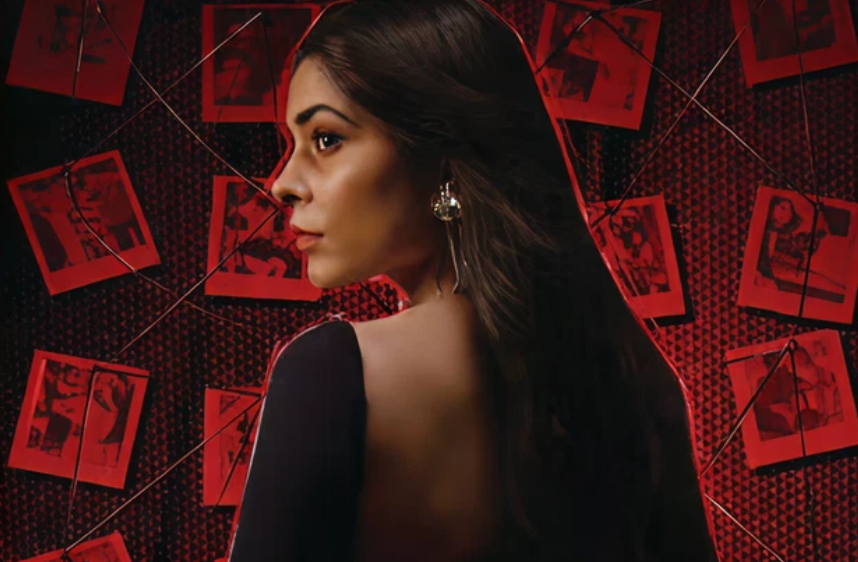
Every medium has its origin story — the moment when someone decides to take seriously a format that the industry hasn't yet agreed to respect. For Indian vertical micro-fiction, that moment arrived in March 2025, when Orange Elephant Studios and Dot Media announced the launch of 'Unmatched': India's first-ever vertical micro-fiction web series. It aired exclusively on Instagram, on a dedicated handle called @fictionloop, built specifically to house premium original vertical content. It was, in retrospect, a quietly radical act. Not radical in the sense of disruption-for-its-own-sake, but radical in the original sense: going back to the root of what storytelling is supposed to do, and asking whether the format then dictates the platform, or whether the platform should shape the format from the beginning.
'Unmatched' didn't emerge from a vacuum. The surge of Korean drama culture across Asia, and the explosion of micro-fiction applications in China — where serialised, vertical-format dramatic content has become a multi-billion-dollar industry — provided both proof of concept and creative provocation. If audiences in those markets were demonstrably willing to follow serialised fiction on their phones, the question for Orange Elephant was whether the Indian audience, equally comfortable with their smartphones, equally hungry for emotionally resonant stories, was ready for the same. The answer, evidenced by the comment sections of 'Unmatched' episodes filling with viewers demanding more, was a decisive yes.
What most observers underestimate about vertical micro-fiction is the degree to which it demands a completely different writing and directing vocabulary. The format isn't simply a shorter version of something else. A three-act structure compressed into a few minutes, with a cliffhanger that must land precisely and a hook that must engage within the first seconds of viewing — this is a discipline closer to poetry than prose, where every word and frame carries weight that a longer format could afford to distribute more evenly. Afroz Khan and Omkar Phatak, who created 'Unmatched', are among the few practitioners in India who have actually mastered this vocabulary. The writing is built for a viewer whose thumb is one gesture away from moving on. Every scene justifies its own existence. Every episode earns its cliffhanger. The production choices — from framing to sound design — consistently reinforce the intimacy that the vertical canvas makes possible.
One of the most significant things about 'Unmatched' was what it chose not to do. The series launched without the backing of a brand or advertiser — a deliberate, principled decision. In an environment where most digital content derives its existence from some form of commercial sponsorship, Afroz Khan's choice to produce the show independently was a statement about what this studio was trying to build. "Making content without the S&Ps of a brand is a privilege that one must savour whenever possible," he said at the time. "It could mean that you front the production yourself but at least there's liberty of thought." That liberty is visible in the work. 'Unmatched' features Sakshi Keswani and Akshay Anand Kohli, alongside Kiann and Sakshi Sneh — a cast that brings together digital creator energy and theatre-trained discipline, producing a texture that feels simultaneously native to social media and elevated beyond it. Meta leaned into the project, further underlining its significance for India's digital content landscape.
The launch of @fictionloop as a dedicated Instagram handle for premium vertical micro-fiction wasn't just a distribution decision — it was an infrastructure decision. Orange Elephant and Dot Media weren't just releasing a show. They were creating a publishing channel, a home for a format, a place where an audience could build the habit of turning up for fiction. This distinction matters because it reveals the long-term thinking behind 'Unmatched'. The ambition was never just one series. The ambition was to establish vertical micro-fiction as a legitimate, sustainable content category in India, with Orange Elephant at its centre. 'Unmatched' was the founding document — the first proof of a standard they were committed to maintaining.
Timing is rarely accidental in creative industries. Orange Elephant's decision to launch 'Unmatched' before the micro-drama wave was fully visible in the mainstream Indian market gave them something invaluable: the first-mover advantage. They didn't just arrive early. They arrived early enough to define what "good" looks like in the format, before there were competitors setting different definitions. The results of that timing are now visible across their subsequent output — from the horror micro-film 'How Do You Live?' featuring Mukti Mohan, which won international festival recognition, to the AJIO 'Suit Yourself' series that became India's largest branded micro-fiction property. Each project built on the vocabulary established in 'Unmatched', deepening Orange Elephant's fluency in a format they had not simply adopted, but authored.
'Unmatched' is now a historical document as much as a piece of entertainment — evidence of a moment when a studio decided to bet on a format before the market had confirmed it was safe to do so. That bet is now paying dividends that would have seemed ambitious even in the optimistic imagining of its creators. India's vertical micro-fiction ecosystem exists in its current form, in large part, because two people chose to make a show on Instagram without a safety net, and trusted that story, told well, in a frame designed for the device in your hand, would be enough. It was. It is. And the conversation it started shows no signs of ending.

