
Let’s Create Impactful Stories Together
As attention spans compress and content volumes explode, micro-drama has emerged as something the digital ecosystem has been quietly building towards for years: stories that fit the feed without surrendering to it.
June 8, 2026
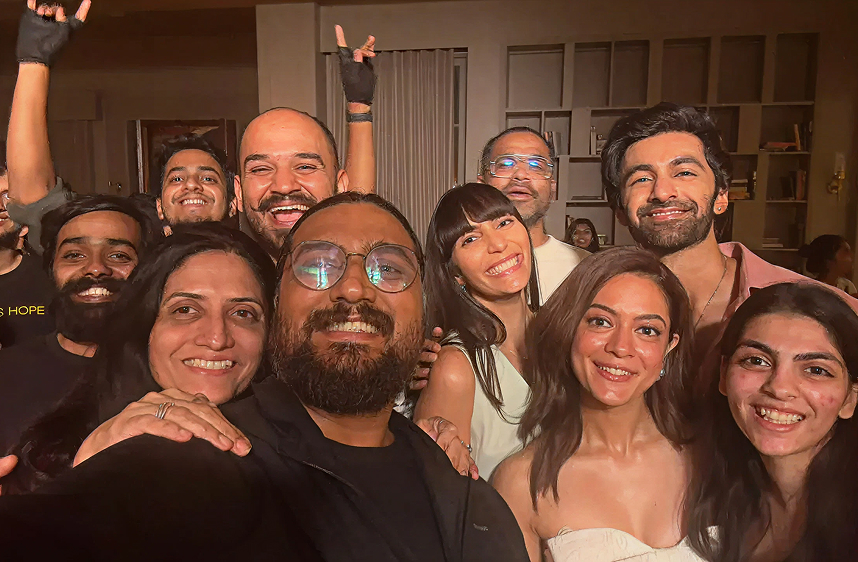
Nobody sat down one day and designed the attention economy. It assembled itself, gradually, from the compounding logic of infinite scroll, algorithmic recommendation, and the human nervous system's ancient bias towards novelty over depth. The result is a content landscape that can feel simultaneously overwhelming and surprisingly thin — vast in volume, uncertain in meaning. Into this environment, micro-drama has emerged not as the cause of attention fragmentation but as its most honest creative response. Orange Elephant Studios' recent work — 'Unmatched', 'How Do You Live?', and the AJIO 'Suit Yourself' series — represents a particular approach to this environment: not adapting to it by doing less, but by doing something different, something that treats short runtime as a formal constraint with its own creative possibilities.
The streaming era produced extraordinary content and exhausting choices. Audiences who might have committed happily to a season of ten one-hour episodes are increasingly selective about that investment, aware that for every series worth the time, there are several that are not. OTT fatigue is real. It doesn't mean people are watching less — it means they are becoming more deliberate about what they commit to, and increasingly attracted to formats that don't require a multi-hour investment before the story proves itself. Micro-drama — serialised fiction in ultra-short episodes, designed for mobile-native consumption — addresses that calculus directly. Six episodes of three minutes each ask less of the viewer than a single streaming pilot. But if the story is sharp, if the cliffhangers land, the cumulative emotional investment can rival formats that are many times longer. The compression isn't a limitation. It's a sales pitch.
Understanding why micro-drama works requires understanding what 180 seconds can hold, when used correctly. It is, in the hands of a skilled storyteller, enough time for a complete emotional beat. Enough for a relationship shift. Enough for a revelation that recontextualises everything before it. What it is not enough for is waste — for scenes that exist to fill runtime, for dialogue that circles rather than arrives, for visual sequences that don't earn their place in the architecture. This constraint is, paradoxically, a gift. It forces the writer and director to identify the load-bearing moments of the narrative and build everything around them. The result, when executed at the level Orange Elephant consistently delivers, is a density of narrative experience that longer formats sometimes dilute. Every second is doing something. The viewer, attuned to content that often doesn't, notices.
Micro-drama's growth is not only a creative story. It's also a platform story. Instagram's architecture — its Reels algorithm, its episodic content support, its native audience for vertical video — is functionally designed to reward exactly the kind of content that micro-drama produces. Short, emotionally engaging, cliffhanger-driven content that generates repeat daily visits from viewers waiting for the next episode is, from the algorithm's perspective, ideal. It increases time-on-platform, drives return sessions, and generates the sharing behaviour that multiplies organic reach. The alignment between micro-drama's creative logic and Instagram's platform priorities is not coincidental. Studios like Orange Elephant, which developed their vertical content expertise on Instagram from the launch of 'Unmatched', understood this alignment intuitively. They weren't just making good content for Instagram. They were making content that worked with Instagram's architecture rather than against it.
The arrival of brands in the micro-drama space — most visibly through AJIO's 'Suit Yourself' — marks a significant maturation of the format. When brands begin investing at the level AJIO committed to, with the production ambition that Orange Elephant delivered, it signals that micro-drama has crossed from experimental territory into proven creative real estate. What brands discover in the format, when approached with the storytelling discipline that distinguishes 'Suit Yourself' from its less crafted competitors, is a way of building audience relationships that interruption-based advertising cannot. A viewer who spends twenty minutes across six episodes in a story a brand has told — and who comes back each day for more — has a relationship with that brand that a thirty-second pre-roll cannot purchase.
The global micro-drama market is significant and growing. Chinese micro-fiction apps have accumulated user bases in the hundreds of millions. American platforms are developing their own short-form serialised content strategies. The question for Indian creators and studios is not whether the format will grow but whether India will develop its own distinctive voice within it — or whether, as American and Chinese platforms enter the market, local storytelling will be defined by their imported templates. Orange Elephant's systematic investment in Indian-context vertical micro-fiction — stories that emerge from Mumbai apartment dynamics, from the specific emotional textures of urban Indian young adult life, from a cultural sensibility that doesn't translate cleanly from any other market — is an argument for the latter. The first-mover advantage they've built isn't just commercial. It's aesthetic. They are establishing what Indian micro-drama sounds and feels like, before that definition can be made for them by someone else.
The micro-drama revolution in India is still in its early chapters. The format is growing faster than the infrastructure to support it, and the gap between quality-driven studios like Orange Elephant and the volume producers flooding the space is wide enough to still be visible. But the direction is clear. As platform architecture continues to reward short-form serialised content, as brand investment follows audience attention, and as audiences discover that the most compelling stories sometimes arrive in the smallest packages, micro-drama's place in the Indian content ecosystem is no longer in question. The scroll has found its story. The story is learning to live in the scroll. And a handful of studios are proving, episode by episode, that these two realities don't have to be in conflict.

