
Let’s Create Impactful Stories Together
When Orange Elephant Studios and Dot Media launched India's first vertical micro-fiction web series, they weren't just releasing content. They were proposing a new relationship between story and screen
June 8, 2026
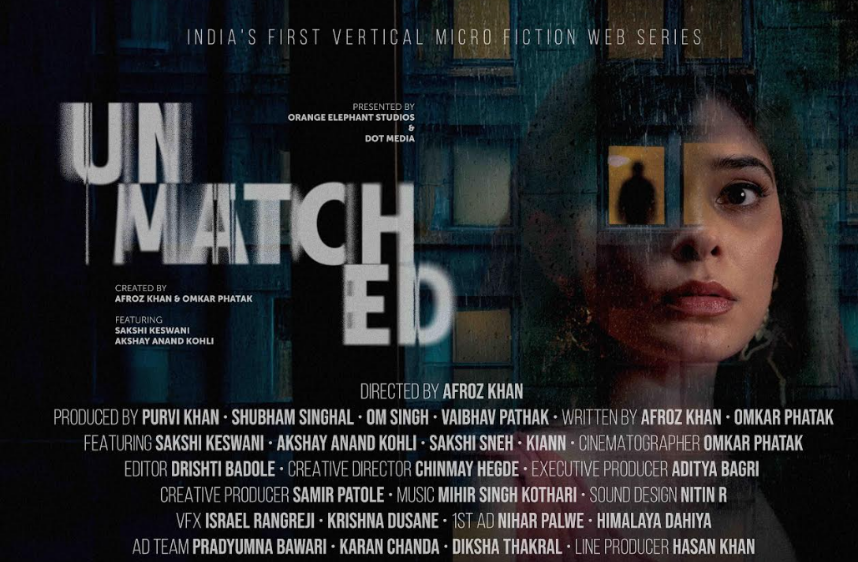
The Indian digital contentmarket has, over the past decade, seen several genuine revolutions — the riseof YouTube creators, the OTT explosion, the short-form boom of Reels andShorts. Each shift has reshuffled the deck for creators, distributors, and audiencesalike. The launch of 'Unmatched' by Orange Elephant Studios and Dot Media inearly 2025 belongs to that lineage of genuine shifts, not merely as a newformat but as a new relationship between storytelling and the device that morethan a billion Indians carry in their pockets. The series — created by Afroz Khan and Omkar Phatak, distributedexclusively through @fictionloop on Instagram — was India's first verticalmicro-fiction web series at significant scale. It was also, perhaps moreimportantly, India's first serious argument that the smartphone is not just adelivery mechanism for content designed elsewhere, but a creative context untoitself, capable of generating a storytelling form native to its dimensions.
India's relationship withthe smartphone is unlike that of most major markets. For a significant portionof the country's internet users, the phone is not a secondary screen — it isthe only screen. Entertainment, news, communication, commerce: the smartphonemediates all of it. Understanding this is not a demographic observation. It's acreative one. Content designed with the phone as an afterthought — shot forwidescreen, cropped for vertical, consumed on a device it wasn't built for — iscontent that has already lost something essential. 'Unmatched' was designed from the first framefor the phone. Vertical composition, intimate close-ups, a pace calibrated forthe rhythms of mobile viewing, a cliffhanger structure that exploits theepisodic logic of daily digital habits — everything about the show's formalchoices assumes the phone as the primary context, not an accommodated one. Thatassumption, though it sounds simple, changes everything about how the story canwork.
One of the most significantthings about 'Unmatched' is what it chose to exclude from its creative process:brand involvement. In a market where most digital content is commerciallysupported — where a brand brief, however liberally interpreted, shapes what astory can and cannot be — the decision to produce 'Unmatched' withoutadvertising backing was a statement about creative sovereignty. Afroz Khan was direct about this logic at thetime of the series' launch. The freedom to tell the story without brandconsiderations — to make a thriller rather than a romance because the storydemanded it, regardless of what was cheaper or safer or more commerciallyobvious — was the creative condition he was protecting. That protection isvisible in the work. 'Unmatched' has the coherence of a story told from theinside, not a story built around an external brief.
The inspiration for'Unmatched' didn't emerge from a purely local creative vacuum. The explosivesuccess of K-drama culture across Asia — stories that travel across linguisticand cultural barriers on the strength of emotional universality — and the micro-fictionapp ecosystem in China, where serialised short-form drama has become asignificant industry, provided both creative validation and competitivecontext. India's storytelling culture isdeep, diverse, and distinctively its own. But it has not, historically, led theglobal conversation in digital-native short-form narrative. 'Unmatched' was, inpart, a claim that it should. That Indian storytellers, working from Indianemotional textures and social contexts, have as much to contribute to theglobal micro-fiction conversation as their Korean or Chinese counterparts. Thatclaim is now easier to sustain than it was before the series launched.
The casting choices in'Unmatched' reflect a specific and intelligent theory about what verticalmicro-fiction needs from its performers. Sakshi Keswani — a digital creatorfluent in the native language of social platforms, comfortable in front of acamera that is also a phone — brings authenticity to the format that comes fromlived experience of it. Akshay Anand Kohli — a theatre-trained actor and actingcoach, steeped in the discipline of live performance and character construction— brings structural rigour. Together,they produce a texture that neither could generate alone: content that feelsgenuinely at home on Instagram while being held together by craft foundationsdeeper than most Instagram content can claim. That combination is notaccidental. It reflects a considered theory of what the format requires — andwhat it can become when those requirements are met.
The decision to house'Unmatched' on a dedicated handle — @fictionloop — rather than distributing itthrough an existing content ecosystem was a publishing decision as much as adistribution one. Orange Elephant and Dot Media were not just releasing a series.They were building a destination: a place where vertical micro-fiction of aspecific quality would live, where audiences could develop a relationship notjust with a single show but with a curatorial sensibility. This model has precedents in other media —the boutique literary publisher, the independent film festival circuit, thecurated streaming channel — but it is relatively rare in the Indian socialmedia context. Its success with 'Unmatched' suggests that audiences are willingto follow a destination if the content at that destination consistentlydelivers what it promises. And Orange Elephant's track record suggests they arewilling to make that promise seriously.
'Unmatched' did not changeIndian digital storytelling with a single dramatic intervention. It changed itthe way most enduring shifts occur: quietly, consistently, by demonstratingthrough practice that something new was possible, and then building the infrastructureto make that possibility repeatable. Orange Elephant Studios and Dot Mediadidn't declare a revolution. They made a series. The revolution, in retrospect,is what the series turned out to be.

