
Let’s Create Impactful Stories Together
With AJIO's 'Suit Yourself', Orange Elephant Studios has done what few branded content houses manage: made the brand invisible and the story undeniable.
June 8, 2026
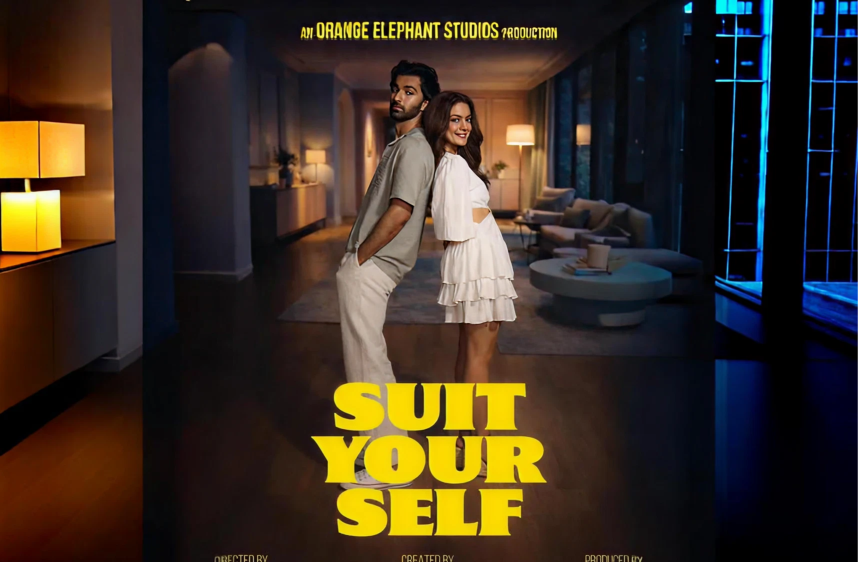
There's a tension at the heart of branded content that most studios quietly accept as the cost of doing business. The brand pays. The brand appears. The audience tolerates — or skips. The transaction is managed, not solved. Orange Elephant Studios, the Mumbai-based digital-first production house founded by director Afroz Khan and producer Purvi Khan, appears to have decided that this compromise is both unnecessary and creatively dishonest. Their latest work — 'Suit Yourself', a six-episode micro-fiction series produced for AJIO — has generated the kind of industry conversation that usually follows a prestige OTT release, not a branded Instagram campaign. The reason isn't the production values, though those are notable. It's the underlying philosophy: that a brand earns its place in a story, rather than buying it.
Orange Elephant's approach to branded content is closer to a publisher's editorial strategy than a traditional agency's production model. Where an agency asks "how do we make the brand central?", Orange Elephant appears to ask a more dangerous question: "what story do audiences actually want to watch?" Then it works backwards from the answer, finding the seams where a brand can be threaded in without pulling the fabric apart. With 'Suit Yourself', the result is a drama where AJIO's fashion is present but never intrusive. Clothes appear as extensions of character psychology, not as product placements. A character's choice of what to wear — or what to keep on, despite everything — becomes an emotional signal in the story's architecture. The brand is doing narrative work, not advertising work. That distinction matters enormously.
The choice to build 'Suit Yourself' for vertical, mobile-first viewing wasn't simply a distribution decision. It was a formal one. Vertical framing fundamentally changes what a story can do — it brings faces closer, eliminates peripheral distraction, creates an intimacy that widescreen struggles to replicate. For a series built on emotional subtlety, that intimacy is load-bearing. Orange Elephant, along with co-founders and producers who have spent years developing content for digital-native audiences, recognized this early. Their micro-fiction work consistently treats the vertical frame as a compositional language unto itself, not a cropped version of something designed for another screen. This is rarer than it sounds. Most vertical content is still horizontal content cut down. 'Suit Yourself' was conceived, shot, and edited for the phone — and it shows in every frame.
The decision to cast Anya Singh — a film and OTT actor with significant profile — in 'Suit Yourself' sent a message that no press release could. Talent of Singh's calibre doesn't sign onto projects out of curiosity. They sign when the material is worth the investment of time and reputation. Her presence in the series was, effectively, a quality signal before a single episode aired. This matters because micro-fiction in India has, until recently, been associated primarily with creator-driven content — often brilliant, often experimental, but rarely featuring faces that have appeared on theatrical screens. Orange Elephant's decision to build their vertical content properties around known, respected talent is a deliberate positioning move. It says: this format is not a stepping stone to something better. This is the destination.
The launch of 'Suit Yourself' as the inaugural title under AJIO Originals — the brand's new branded content slate — deserves attention as a business story, not just a creative one. Building a content slate implies a commitment to catalogue, not campaign. It means investing in the long-term cultural equity of a content library, not just the short-term metrics of a single activation. This model is familiar from global streaming platforms. It's what made HBO synonymous with quality drama decades before streaming existed, and what makes A24 a brand as much as a studio today. The bet AJIO and Orange Elephant are making is that the same logic applies to brand-owned content: that building an audience relationship through consistent, high-quality storytelling pays dividends no ad spend can buy — in recall, in loyalty, in the kind of cultural presence that money cannot simply purchase.
The broader question raised by 'Suit Yourself' is what happens to branded storytelling in India when the format matures. Early iterations of every new content form are defined by their pioneers — the studios and brands willing to absorb the risk of invention. Orange Elephant's track record, from 'Rat in the Kitchen' to 'Unmatched' to 'Suit Yourself', suggests a studio that has systematically built competency in short-form, high-craft storytelling across multiple contexts. Their 2025 vertical web series slate — seven shows developed simultaneously — suggests that this isn't a happy accident of a single commission, but the output of a deliberate infrastructure. As American and Chinese micro-fiction platforms begin to eye the Indian market, the studios already fluent in this language will have a structural advantage. Orange Elephant's consistent investment in the format means they're not learning in public. They're already operating.
Orange Elephant Studios hasn't simply made a very good branded campaign. They've demonstrated — in six episodes, 180 seconds at a time — that the entire premise of branded content can be rethought from the ground up. Not by abandoning what brands need, but by trusting that stories well told will do more commercial work than any interruption ever could. In the industry's long argument about whether branded content can be art, 'Suit Yourself' puts a very clean answer on the table: it can. When the right studio, the right brief, and the right format converge, the seam between art and commerce doesn't just blur — it disappears entirely.

